Technical Grade
SS 202
Surface Texture
Interior Mirror / Exterior Matte Specialist
Technical Reading
Matte Specialist: Achieving the Perfect Satin Texture (Ra Values)
Wok & Frying Pan Finishing
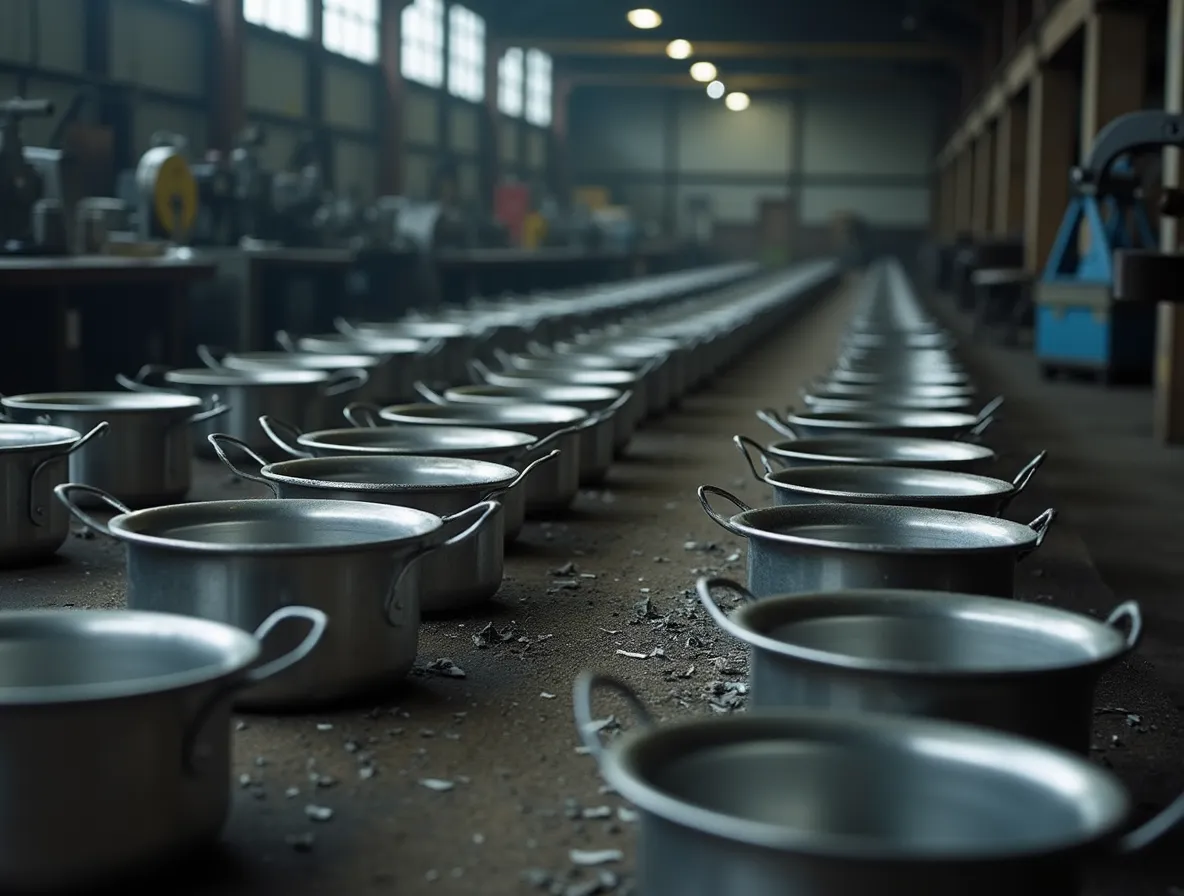
Woks, kadhais, and deep frying pans require a dual-finish protocol that no single-pass buffing system can handle correctly. The interior demands a smooth, food-contact-safe surface that resists oil carbonization and cleans easily under commercial kitchen conditions. The exterior faces direct flame contact, abrasive surface wear, and constant handling -- conditions where a mirror finish degrades visibly within weeks. Our wok finishing protocol runs a high-RPM interior smoothing pass on the food-contact surface and our signature matte specialist finish on the exterior, producing a durable satin grain at Ra 0.5μm that disperses abrasion rather than concentrating it.
Engineering Specs
The Finishing Workflow
Surface inspection -- grade identification and handle configuration assessment
Weld-seam leveling at handle attachment points (welded configurations)
Interior high-RPM smoothing pass on food-contact surface and base joint
Handle and rim edge buffing -- interior-to-exterior transition zone
Exterior matte precision polisher pass at calibrated Ra 0.5μm
Grain-direction alignment check under directional lighting
Final heat-cycle surface audit for exterior finish stability
Service Includes
Why Woks and Kadhais Need a Dual-Finish Protocol
Most buffing operations apply a single finish to the entire utensil surface. For milk pots and sauce pots this is acceptable -- the interior and exterior face similar conditions. For woks and deep frying pans it is the wrong approach. The interior is a food-contact surface operated at high temperature with oils and liquids -- it needs to be smooth enough to prevent food adhesion and easy to clean, but it does not need to be mirror-grade because the abrasion from cooking utensils will degrade a mirror surface quickly regardless. The exterior is a different environment entirely: direct flame or induction heat, abrasive contact with burner grates, stacking pressure from other utensils, and constant handling by kitchen staff. A mirror exterior on a commercial wok looks degraded within a month of service. A matte exterior at Ra 0.5μm -- our standard external finish -- disperses the abrasion load across the grain structure rather than concentrating it into visible scratch lines. The result is a utensil that maintains its appearance and surface integrity significantly longer in a commercial kitchen environment. This is why our wok finishing protocol uses two different machines, two different compound assignments, and two separate passes -- because the interior and exterior are genuinely different finishing problems.
Interior Smoothing: What High-RPM Surface Finishing Achieves
The interior of a commercial wok or kadhai is subject to direct contact with cooking oils, acidic ingredients, and metal utensils during service. Our interior pass uses high-RPM buffing on the 20-motor array to produce a smooth surface that resists oil carbonization -- the process by which cooking oil polymerizes and bonds to rough metal surfaces under repeated high-heat cycles. A smoother interior surface carbonizes less, cleans faster, and maintains food safety compliance longer. The interior pass also addresses weld seams at the base joint and handle attachment points, which are the areas most prone to carbon buildup in high-heat applications.
External Matte Specialist Finish: The Ra 0.5μm Standard
Our external matte finish targets Ra 0.5μm -- a surface roughness that creates a unidirectional satin grain visible as a consistent texture across the exterior body of the utensil. At this Ra value, the grain structure is deep enough to give the matte appearance but shallow enough that the surface remains easy to wipe clean. More importantly, Ra 0.5μm disperses abrasive contact across multiple grain peaks rather than allowing a single scratch line to form -- which is why matte exteriors outperform mirror exteriors in commercial kitchen environments where surface contact is constant. This is the same finish standard used on premium export cookware. Read the full technical breakdown in our matte specialist Ra value guide.
SS 202 vs SS 304 Kadhais: How the Grade Affects the Protocol
SS 202 is the more common grade in commercial kadhai manufacturing due to its lower cost and adequate corrosion resistance for kitchen environments. SS 304 offers higher nickel content and greater resistance to acidic ingredients and aggressive cleaning chemicals. The buffing implication is the same as with other utensil types: SS 202 work-hardens under aggressive compound pressure, so our SS 202 protocol uses a lighter compound formulation and lower RPM on the exterior matte pass to prevent micro-tearing the surface grain. SS 304 handles the full compound protocol. Mixed-grade consignments are processed in separate passes per grade. For the technical difference between SS grades in buffing, see our SS grade buffing guide.
Welded vs Riveted Handle Configurations
Woks and kadhais come with two primary handle attachment methods: welded handles (a single continuous weld bead around the handle base) and riveted handles (mechanical fasteners through the body wall). Both require specific treatment during buffing. Welded handle joints are addressed with a weld-seam leveling pass before the main interior and exterior buffing stages -- the same thermal blueing removal process used on sauce pot handles. Riveted configurations require edge protection around each rivet point during the exterior matte pass, because the compound wheel must not contact the rivet head directly or it will create an uneven surface profile around the fastener. Both configurations are supported in our standard wok finishing workflow.
High-Heat Durability: What the Surface Finish Does Under Flame
Commercial woks and kadhais operate at temperatures that standard cookware finishes are not designed for. Direct flame contact on the exterior can reach 400-600°C at the base. At these temperatures, a mirror-polished exterior surface begins to show heat discolouration (blueing) within the first few uses. A matte exterior at Ra 0.5μm is more thermally stable in terms of appearance -- the satin grain structure is less reflective, so heat discolouration is less visually prominent and distributes more evenly across the surface. We also run a final heat-cycle surface audit on wok batches specifically to verify that the exterior finish is stable under the thermal stress typical of commercial burner use.
Batch Logistics and HSN 7323 Compliance for Wok Manufacturers
We accept wok and kadhai polishing batches from 100 units upward from manufacturers and distributors across Vasai East, Boisar, Palghar, Thane, and the Mumbai industrial corridor. Standard batches dispatch within 24-48 hours of receipt at our Vasai East facility. All job-work is invoiced under HSN Code 7323 with full GST documentation. B2B manufacturers can claim input tax credit on the job-work service charge. For a complete breakdown of HSN 7323 billing and what documentation you need, read our HSN 7323 compliance guide.
Mirror Finish vs Matte Finish: Which Is Right for Your Batch?
| Aspect | Mirror Finish | Matte / Satin Finish |
|---|---|---|
| Exterior Appearance After 1 Month | Visible scratch accumulation from burner grate and utensil contact | Consistent satin grain -- surface abrasion dispersed, not concentrated |
| Heat Discolouration Visibility | High -- reflective surface makes blueing and heat marks prominent | Low -- satin texture diffuses discolouration across grain structure |
| Fingerprint and Oil Mark Visibility | High -- every contact mark visible on reflective surface | Minimal -- fingerprint-resistant grain at Ra 0.5μm |
| Interior Finish | High-RPM smoothed food-contact surface -- same in both protocols | High-RPM smoothed food-contact surface -- same in both protocols |
| Commercial Kitchen Lifespan | Appears worn within 4-6 weeks of intensive service | Maintains consistent appearance for 6-12+ months in the same conditions |
| Best Application | Display cookware, retail presentation, low-frequency use | Commercial kitchens, hotel operations, catering, export cookware |
Not sure which finish suits your application? Contact our finishing specialists or read our matte finishing Ra value guide.
Technical FAQ: Wok & Frying Pan Finishing
What finish do you apply to the exterior of woks and kadhais?
We apply our signature matte specialist finish to wok and kadhai exteriors -- a fingerprint-resistant satin texture at Ra 0.5μm. This is the same finish used on premium export cookware. It outperforms mirror exteriors in commercial kitchen conditions by dispersing abrasive contact across the grain structure rather than concentrating it into visible scratch lines. Read the full technical detail in our matte specialist guide.
What finish do you apply to the interior of woks?
The interior receives a high-RPM smoothing pass on our 20-motor buffing array. This produces a food-contact-safe surface that resists oil carbonization -- the bonding of polymerized cooking oil to rough metal surfaces under high-heat cycles. The interior pass also levels weld seams at the base joint and handle attachment points.
Can you buff SS 202 and SS 304 woks in the same consignment?
Yes. Both grades are accepted in the same order and processed in separate machine passes. SS 202 requires a lighter compound formulation and lower RPM on the exterior matte pass to prevent micro-tearing the surface grain. SS 304 handles the full compound protocol. A single HSN 7323 invoice covers the full mixed-grade consignment.
Do you handle woks with welded handles and riveted handles?
Yes. Welded handle joints receive a weld-seam leveling pass before the main buffing stages -- the same thermal blueing removal process used on sauce pot handles. Riveted configurations receive edge protection around each rivet point during the exterior matte pass to prevent uneven surface profile formation around the fastener.
How does the matte exterior finish hold up under direct flame and commercial kitchen conditions?
Better than a mirror exterior by a significant margin. At Ra 0.5μm the satin grain disperses abrasive contact rather than showing it as individual scratch lines. Heat discolouration is also less visually prominent on a matte surface because the satin texture diffuses the reflection. We run a heat-cycle surface audit on all wok batches to verify the exterior finish is stable under commercial burner temperatures before dispatch.
Do you also buff deep frying pans and flat kadhais, not just round woks?
Yes. The dual-finish protocol applies to all high-heat utensil types -- round woks, flat-bottomed kadhais, deep frying pans, and induction-compatible variants. Handle configuration (welded or riveted) and base type (flat or curved) are assessed at the surface inspection stage and the workflow is adjusted accordingly.
Related Services
All Services

Technical Insight
Matte Specialist: Achieving the Perfect Satin Texture (Ra Values)
Equipment
See the machinery behind this service
Every finishing operation on this page runs through a grade-calibrated machine protocol. Our 20+ motor fleet, matte polisher, beading lathe, and fiber laser are available for inspection.